Why the stage defines the investment
Every stage of the solar project lifecycle carries a different mix of risk, capital need and control. Early stages require less capital but expose the investor to authorisation and connection uncertainty. Later stages cost more but remove most development risk, leaving construction, market and operating risk. There is no right entry point in general; there is the one that fits a given mandate.
The stages also shape the relationship with the seller. Early on, the investor works alongside a developer over a period of time; at RTB and beyond, the relationship is closer to a single transaction with a defined set of documents and conditions.
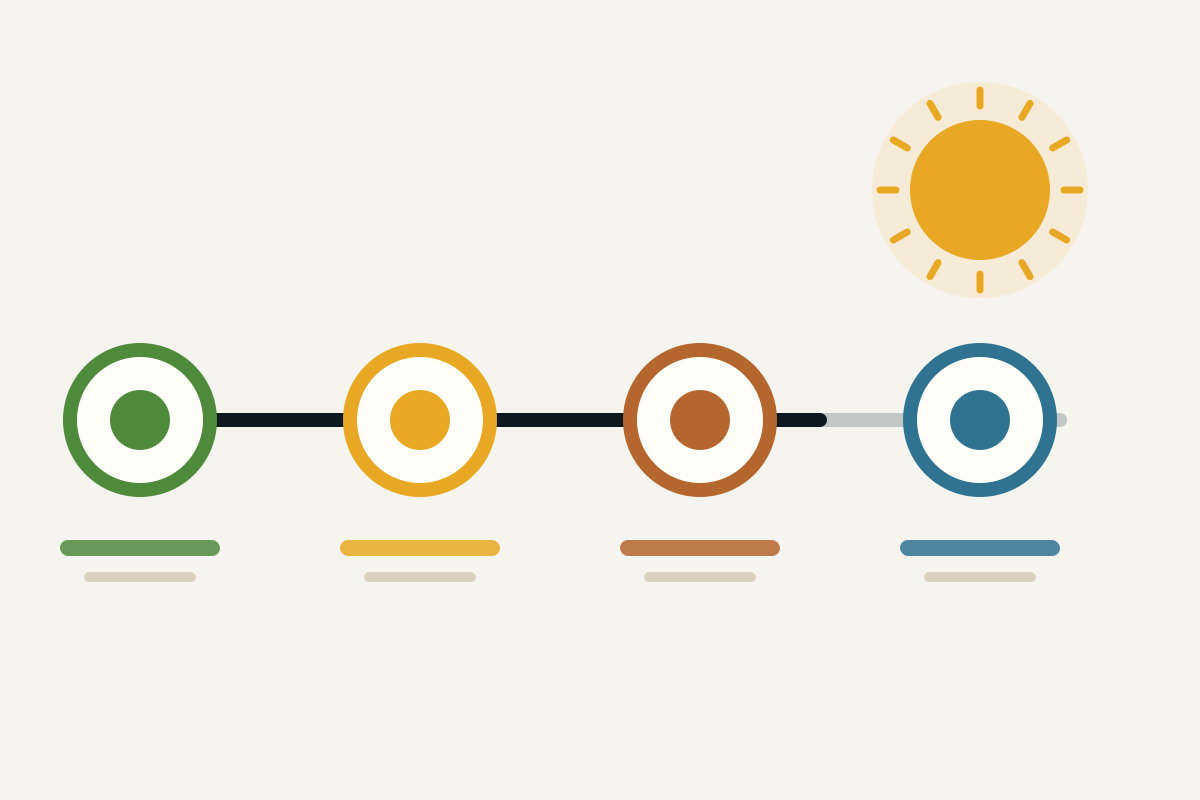
On Pipeline.Solar the lifecycle is grouped into four searchable stages: greenfield, RTB, brownfield and COD. Below is the step-by-step view behind them.
Stage 1: origination and site screening
The developer identifies land and checks it against planning constraints, the national and regional rules on suitable areas (aree idonee, under the Ministerial Decree of 21 June 2024 and regional laws) and, for ground-mounted plants on agricultural land, the limits introduced by Decree-Law 63/2024. Proximity to the grid and the likely connection point are assessed at the same time.
Typical documents: cadastral extracts, urban planning certificates, constraint maps, preliminary layout, landowner contacts.
Stage 2: land rights and grid request
The developer secures the land, usually through an option for a surface right (diritto di superficie, articles 952 and following of the Civil Code) or a purchase option, and files the connection request with Terna or the local distributor. The grid operator issues an STMG, which must be accepted within the applicable terms under the TICA rules. Our guide to STMG and TICA covers this step in detail.
Typical documents: option or preliminary agreements, connection request, STMG and proof of acceptance, payment receipts.
Stage 3: authorisation
The project is designed and filed under the regime that applies to it. Legislative Decree 190/2024 reorganises the regimes into free activity, PAS and autorizzazione unica (AU). Depending on the project, a VIA or a screening procedure may be added. Once the title is effective and the other pillars are in place, the project is RTB. See PAS and AU solar permitting and what RTB means in solar.
Typical documents: authorisation filing and attachments, opinions from authorities, environmental assessments where required, the final title.
Projects that have filed but not yet obtained the title, or that still need to sign the land agreement, fall into the late-stage group.
Stage 4: financing, EPC and construction
The owner selects an EPC contractor, closes financing and issues the NTP (Notice to Proceed). Construction covers the plant itself and, where required, the user and network works for the connection. Revenue schemes are also defined here: a PPA, participation in FER X through the GSE, or merchant exposure.
Typical documents: EPC contract, executive design, financing documents, works logs, test certificates.
Stage 5: ready for connection, then COD
A completed plant waits for the grid operator to finish its works and energise the connection. On this site that phase is called brownfield. Once the plant is connected and producing commercially, it reaches COD (Commercial Operation Date) and enters the operating phase, with O&M contracts and a production history.
Typical documents: commissioning reports, grid operating agreements, O&M contract, production data, offtake contracts.
Solar project development stages at a glance
The table summarises the lifecycle from the investor's side. It describes the nature of the risk, not its size, which always depends on the individual project.
| Stage on this site | What the investor acquires | Main open risks |
|---|---|---|
| Greenfield | A development path, paid by milestones | Authorisation, connection, land |
| Late-stage | A project with one or more items still missing | The specific missing items |
| RTB | Permits, accepted STMG and land rights | Construction, CAPEX, market |
| Brownfield | A built plant awaiting connection | Network works, energisation date |
| COD | An operating plant with production history | Performance, prices, O&M |
For a structured comparison including technologies such as BESS and agrivoltaic, see solar project types in Italy.
Matching the stages to your search on Pipeline.Solar
When you register, you choose one or more stages, a minimum and maximum capacity for the single plant, regions, technologies and structures such as share deal, asset deal or co-development. Projects are not published: each one is screened by the staff and, if it fits your range, sent to you as a teaser from deal@pipeline.solar. The documents listed above become available in the data room after an NDA. Our solar data room checklist groups them by stage.
To decide where to start, request investor access and set your stages, or send a message on WhatsApp. Opportunities depend on the projects available at the time.
Frequently asked questions
What is the difference between greenfield and late-stage?
Greenfield refers to early development, which investors on this site fund through milestone-based co-development. Late-stage projects have most elements in place but still miss one or more, such as an approved PAS.
Can I select more than one stage?
Yes. In the reserved area you can combine stages, for example RTB and brownfield, and set a capacity range that applies to the single plant.
Where does brownfield sit in the lifecycle?
On Pipeline.Solar brownfield means plants built or in their final phase, ready to be connected and awaiting energisation.
How do I set my preferred stages?
After a short call you receive a personal link to the reserved area. You can also complete the access form and let the staff set the criteria with you.